Almost all major Canadian cities prepare climate action plans that contain commitments and actions to address climate mitigations and adaptations. They involve steep investments in all kinds of building and infrastructure, and these investments have commercial impacts across sectors. This is part of a larger movement among cities across the world who have joined global networks like C40 and the Covenant of Mayors to enact ambitious climate action plans to reduce emissions within the terms of the Paris Agreement.
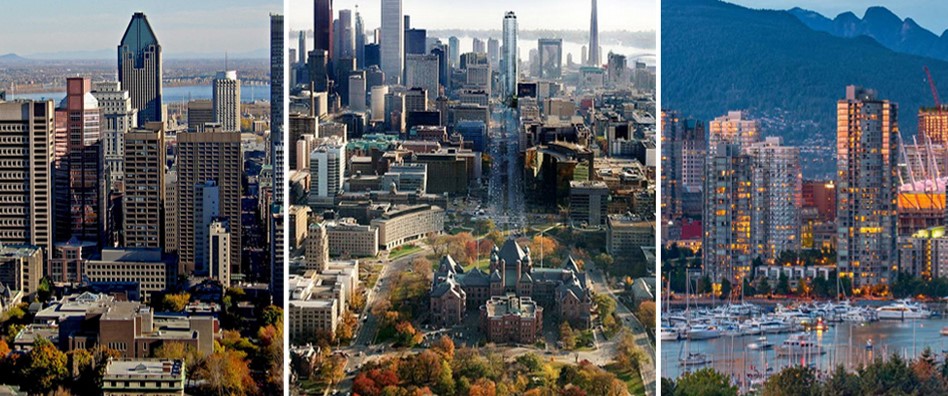
The three biggest Canadian cities, Vancouver, Toronto, and Montreal are active members of C40 and have formalised bold plans through their councils to address the climate crisis.
THE BOLD PLANS
Under the banners of Green Vancouver, Toronto’s TransformTO Net Zero, and Montreal’s Climate Plan 2020-2030, these plans aim to measurably reduce greenhouse gas (GHG) emissions by 2030 and achieve net-zero emissions by 2050 or sooner. They contain a lot of policy, regulation and investment actions that, together, will drive a decades long green transformation. As with any large transformation ambition, the plans encourage collaboration between governments, businesses, and citizens and also involve huge challenges and risks that will impact their success.
Vancouver’s Green Vancouver plan commits to reduce carbon pollution by 50% by 2030 and become carbon-neutral by 2050. It was first established in response to environmental challenges faced in the 1990s. It includes a number of specific actions related to land-use planning, transportation, buildings, infrastructure, and enhanced natural systems. On the accountability side, the city publicly reports its progress on an ongoing basis and uses the latest GHG inventory according to Environment Canada’s National Inventory Report (NIR) guidelines.
There are obvious commercial impacts. The plan includes large new investments in retrofitting municipal and residential buildings. In addition, there is job creation through the protection of natural systems. New building and infrastructure regulations will impact a couple of business sectors from construction to technology.
Toronto’s TransformTO Net Zero Strategy aims to achieve net-zero emissions by 2040- the boldest commitment in North America. The plan builds on the initial TransformTO climate action strategy unanimously approved by the City Council in 2017. There is a focus on energy efficiency in buildings, increasing the share of electric vehicles, expanding renewable and low-carbon energy sources, and waste reduction. The city’s GHG reduction targets, from 1990 levels, are 30% by 2020, 45% by 2025, 65% by 2030, and net-zero by 2040. The City of Toronto also uses Environment Canada’s (NIR) as a primary source for its emission factors. There are regular updates to its annual emissions reductions and other ongoing assessments.
Toronto’s TransformTO Net Zero: Toronto’s TransformTO strategy includes long-term, low-carbon goals and strategies focusing on homes and buildings, energy, transportation, and waste management. The city has ambitious targets, such as ensuring 50% of community-wide energy comes from renewable or low-carbon sources by 2030 and a target of 30% of registered vehicles to be electric. Billions have already been committed to Metrolinx transportation projects, including Line 5 Eglinton, the Ontario Line, and the Line 1 Yonge subway extension. This is not without some challenges. There construction sector may see new building code changes, labor and supply issues, and the pressure to meet residential construction demands. Metrolinx’s transit expansion projects have also faced some famous cost overruns and delays. These kinds of labour and project schedule pressures have not yet had an impact the progress with Toronto’s GHG reductions.
Montreal’s Climate Plan 2020-2030 commits to reduce GHG emissions by at least 55% (below 1990 levels) by 2030 and achieve carbon neutrality by 2050. The plan was established in 2018 as a response to council’s understanding of the urgent need for climate action. The plan contains 46 actions, including 16 key actions, grouped into five sectors: mobilization of the Montreal community, mobility and urban planning, buildings, city properties and operations, and governance.
The plan has an intention to incorporate climate considerations into the city’s future decision-making processes and promotes transparency through regular progress reports. The city also relies on the NIR as a source of information on GHG inventory and updates its emission factors according to the guidelines provided by Environment Canada.
Montreal’s plan has a unique link to the COVID economic recovery and emphasizes resilience. There’s a requirement that all sectors of society to contribute to the ecological transition, like the determination shown by the population in its fight against COVID-19. This kind of messaging around collaboration and recovery is harbinger to the significant challenges still to come with this kind of multi-sectoral transformation and multi-decade targets.
While the climate action plans of Vancouver, Toronto, and Montreal share common goals, they also face challenges and risks that may impact their success. Coordinating these many activities across sectors, addressing labor and supply issues, and dealing with cost overruns and delays in infrastructure projects are some of the challenges that are emerging.
ALIGNMENTS WITH GLOBAL INITIATIVES
The climate action plans of Vancouver, Toronto, and Montreal have key alignments with international climate initiatives such as C40 and the Covenant of Mayors. The Canadian cities’ climate action plans do this by setting ambitious emissions reduction targets, fostering cross-sector collaboration and information sharing, and prioritizing adaptation and resilience.
The C40 network includes over 90 of the world’s largest cities, aims to deliver on the goals of the Paris Agreement by reducing greenhouse gas emissions and climate risks while increasing the health, well-being, and economic opportunities of urban citizens. As members of the C40, these Canadian cities set targets in alignment with the goals of the Paris Agreement.
The emphasis on cross-sector collaboration and information sharing is a feature of the global initiatives. The C40 is a network that facilitates dialogue, knowledge sharing, and best practices among cities to address climate change more effectively.
The cities’ plans align with the C40 network’s focus on adaptation and resilient infrastructure, protected natural systems, and integrated urban planning and development.
CANADA GOVERNMENT SUPPORTS
For Canada’s approximately 3500 municipalities, the climate planning directions from C40, the Covenant of Mayors and the bold directions in the plans of Vancouver, Toronto and Montreal have a large and long lasting influence.
The general momentum around Canada’s local climate action plans has some organizational support, particularly from the Canadian Centre for Climate Services (CCCS) and the Federation of Canadian Municipalities (FCM). The CCCS, which is part of Environment and Climate Change Canada (ECCC), provides climate information and tools to support decision-making. The FCM provides support and resources to municipalities in Canada. Since 2019, both organizations have been supporting the Municipal Climate Services Collaborative (MCSC), a collaborative initiative aimed at providing support to Canadian municipalities in their efforts to address climate change. Together with the MCSC, the CCCS and FCM provide expertise and resources, data and case studies to help municipalities develop and implement effective climate action plans.
There are also several funding programs available to assist municipalities in enhancing resiliency and transitioning to low-carbon economies, such as the Green Municipal Fund (GMF) and the Municipalities for Climate Innovation Program (MCIP). These programs provide funds for feasibility studies, pilot projects, and capital projects related to climate change mitigation, adaptation, and resilience.
Infrastructure Canada, Natural Resources Canada (NRCan), and Environment and Climate Change Canada (ECCC) administer various funding programs that support municipal climate action. These programs support many aspects of climate action plans with funds for resilient infrastructure, climate change adaptation, addressing the impacts of natural disasters, clean energy, and even to raise awareness of the climate crisis.
IMPLICATIONS FOR BUSINESS
Climate action plans, in particular for the large municipalities (Vancouver, Toronto, and Montreal) have numerous impacts on businesses across various sectors. In all three cities, the construction industry will be busy with retrofitting existing buildings, and this will create demand for skilled professionals and green building technologies. The growing market for clean energy technologies, particularly heat pumps and electric vehicles, presents substantial opportunities for businesses in the automotive and clean energy sectors.
The climate action plans of Vancouver, Toronto, and Montreal may demonstrate commitments to take bold action and get real results in addressing the climate crisis. The plans involve significant investments in buildings, infrastructure projects, transportation, waste management and other areas of city operations. As members of the C40 network and the Covenant of Mayors, these cities align their goals with international climate initiatives and invest in adaptation and resilience. The implementation of these plans creates opportunities for businesses to contribute to the ecological transition, while facing the challenges of coordinating activities across sectors and over a long-term time horizon.
The continued momentum of these plans requires ongoing pressure from voters and councils as well as continued funding, collaboration and supports from other levels of government. The biggest challenge remains that delicate balance of prioritizing the urgency of climate action while maintaining the required funds and supports.