
As the global community accelerates its efforts to tackle climate change, carbon markets have emerged as vital instruments for reducing greenhouse gas (GHG) emissions. At the heart of these markets are carbon credits, crediting mechanisms, crediting programs, and carbon standards. Projects participate in carbon markets by demonstrating and verifying their specific contribution to reducing, avoiding, or removing greenhouse gas emissions. These specific contributions, such as capturing methane from landfills, are implemented as activities within a carbon project established for climate change mitigation.
Carbon Projects, Carbon Credits, and Carbon Programs
Developers of carbon projects identify and apply approved quantification methodologies aligned with the requirements of specific standards developed and listed under a crediting program. Once verified, the quantified emissions reductions are issued as carbon credits, which can be traded or sold as offsets. Crediting programs are implemented under frameworks known as crediting mechanisms, such as the Clean Development Mechanism (CDM) and the Article 6.4 mechanism, as compliance frameworks and the voluntary carbon markets, which serve as a voluntary, private sector-driven framework. By adhering to these requirements, carbon offset projects can ensure the credibility and marketability of the carbon offsets they generate. As international carbon markets expand to support climate change mitigation and the Sustainable Development Goals (SDGs), carbon standards have become increasingly central in ensuring the integrity, transparency, and impact of carbon offset projects. In the following, we’ll take a closer look at the emergence of carbon standards and international crediting mechanisms that regulate mitigation activities.
What are Carbon Standards?
Carbon standards are sets of rules and methodologies that guide the quantification, monitoring, verification, and reporting of emission reductions. Crediting programs are broader institutional frameworks, usually managed by organizations or entities, that oversee the development and application of these standards, issue carbon credits, and maintain registries. These programs regulate the issuance and trading of carbon credits generated from avoided, reduced, or removed GHG emissions. As participation in carbon trading expanded, concerns emerged about the consistency and legitimacy of emissions reductions. These standards establish rules and principles that guide the design, implementation, monitoring, and reporting, as well as the validation, quantification, and verification of carbon credits generated by carbon projects. Carbon standards are relevant to proving the additionality claims of projects, i.e., that mitigation activities would not have occurred without incentives from the sale of carbon credits. They also help legitimize the permanence of projects and guide the calculation of leakage, i.e., emissions that occur outside the project area due to mitigation activities implemented in the project area. By legitimizing the claims of offset, the standards also serve to address criticisms regarding the credibility of offset schemes and provide quality assurance to buyers and off-takers of carbon credits.
Carbon standards and crediting Programs work together. For example, Verra is a nonprofit organization that manages multiple carbon credit programs (Verified Carbon Standard, Jurisdictional and Nested REDD+ Framework, Scope 3 Standard, Climate, Community & Biodiversity Standards, Sustainable Development Verified Impact Standard). In addition to developing standards, crediting programs also accredit or certify third-party auditors responsible for reviewing project design and reports of offsets to ensure compliance with standards before the issuance of carbon credits. Through stringent validation and verification processes guided by standards, crediting programs also prevent double counting when emissions reduction or removal is counted more than once.
How Carbon Standards Work
Carbon standards are central to the functionality of crediting programs by serving as essential rulebooks. In addition to being documented for easy implementation, each standard is supported by specific approved methodologies suited to specific mitigation activities. Methodologies are peer-reviewed parameters and formulas that are used to quantify the claims of carbon offsets by a project before certification is issued. These methodologies ensure transparency, scientific rigour, and consistency in calculating a project’s mitigation contributions during its lifetime. While project developers have the flexibility to select which methodologies and standards are most appropriate for intended mitigation activities within the proposed project framework, this selection is influenced by many factors:
- Mitigation Ecosystem: Projects involving activities in forest landscapes may be more suited to the Reducing Emissions from Deforestation and Forest Degradation (REDD) framework.
- Project Scale: Projects aiming to start on a small scale with plans for future expansion or a large-scale initial commitment in terms of emissions reduction targets are better suited to Verra’s Verified Carbon Standard. In contrast, smaller individual projects are more suitable to standards such as the Plan Vivo Standard.
- Marketing of Credits: The VCS and Gold Standard are the world’s most reputable standards in the voluntary carbon market. Project developers may decide to increase their bargaining power during the sale of credits by registering to generate carbon offsets through methodologies developed by either of these crediting programs.
- Project Costs: The cost of validation and verification under Verra programs is higher than in other smaller standards. Similarly, when the CDM was still operational, it was also more expensive, rigorous, and complex for projects to be registered.
After selecting the crediting program, methodologies, and standards most suited for the design of a new project, the crediting program reviews the design and proposed implementation of this activity to ensure compliance with the standard and methodological requirements during validation before the project becomes operational. Compliance is demonstrated through evaluative indicators that assess whether the project design poses a risk to the quality of offsets to be generated. In cases where projects aim to provide additional benefits, such as social and other environmental benefits, such as biodiversity conservation, standards may be required that address these topics in addition to climate mitigation outcomes. After validation, ongoing monitoring throughout the project’s lifetime ensures its continued adherence to the standard requirements. Once project data is collected periodically, an independent third-party verifier assesses the reported emission reductions or removals. If the reductions are confirmed, the standard’s registry issues a certification for credits that can be tracked and traded.
Issued credits can be sold on compliance markets under the Kyoto Protocol or in the voluntary carbon markets, where private entities purchase credits to meet climate goals or offset emissions. This cycle of processes is commonly referred to as Monitoring, Reporting, and Verification (MRV) – an essential component of every carbon project.
To ensure methodological robustness and transparency, many carbon standards establish formal processes for the periodic review and revision of their approved methodologies. These revisions are usually open to public consultation, enabling stakeholders, including project developers, scientists, NGOs, and the general public, to provide input. This participatory process helps identify potential weaknesses, incorporate scientific advancements, and ensure methodologies remain relevant across geographies and project types. For example, Verra regularly updates its methodologies under the VCS program through a public comment period, announced on its website. Similarly, the Gold Standard employs a similar mechanism during methodology development and revision to ensure transparency and stakeholder engagement.
The Emergence of International Carbon Standards
Carbon crediting programs emerged with the United Nations Framework Convention on Climate Change (UNFCCC). The UNFCCC developed the Clean Development Mechanism (CDM) and Joint Implementation (JI) in 1997, following the adoption of the Kyoto Protocol. Under the CDM, rules were developed to govern and standardize the quantification of emissions reduction as part of national commitments to climate change mitigation through projects in developing countries funded by industrialized countries. The JI, on the other hand, involved emissions reduction projects between industrialized countries and economies in transition. In addition to the compliance mechanism, the Voluntary Carbon Market (VCM) has expanded significantly over the years, with several independent standards offering credits for carbon offset contributions.
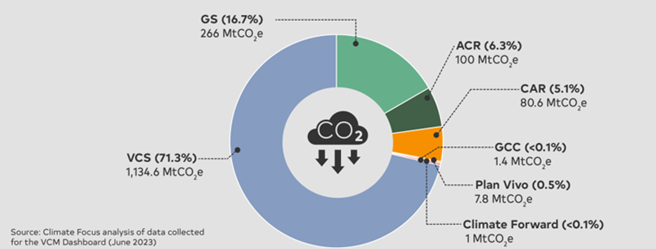
Before the rise of voluntary programs and their criticism, the CDM was criticized for being highly regulated and bureaucratic, resulting in high transaction costs and reduced accessibility, particularly for small-scale projects. The following highlights the world’s leading international standards and their functions. Figure 1 below illustrates the distribution of leading voluntary carbon standards and the issuance of credits in 2023. The compliance market holds a significantly larger share than the voluntary market.
Figure 1: Share of credits issued in the VCM by leading carbon standards
Source: Climate Focus (n.d.)
Clean Development Mechanism: The UNFCCC, in 1997, developed the Clean Development Mechanism (CDM) as a project-based approach to emissions reduction under the Kyoto Protocol. The CDM was governed by rules and principles that allowed industrialized countries to invest in emissions-reducing projects in developing countries in exchange for Certified Emission Reductions (CERs). Each unit of CER was counted as a country’s commitment to meeting its Kyoto targets. The first units of Certified Emission Reductions or carbon credits were issued in 2005 from two hydroelectric power projects in Honduras and Finland. Both projects were validated by a CDM-designated operational entity (DOE). The CDM was the first large-scale international carbon standard. Standards set by the CDM require that projects meet strict criteria, including additionality, utilize approved methodologies, and undergo third-party validation and verification. Projects were also required to seek approval from National Designated Authorities (NDA). Among other functions, NDAs in respective developed countries were required to assess potential projects and ascertain their ability to contribute to achieving set outcomes in the benefiting countries. The CDM has five primary methodologies which serve as tools for quantifying CERs through specific activities. These methodologies are approved by the CDM Executive Board and include;
- Methodologies for Large-Scale CDM Project Activities.
- Methodologies for small-scale CDM project activities.
- Methodologies for Large-Scale Afforestation and Reforestation CDM Project Activities.
- Methodologies for Small-Scale Afforestation and Reforestation CDM Project Activities.
- Methodologies for carbon capture and storage (CCS) project activities.
There were approximately 95 methodologies listed under the large-scale CDM project activities alone. Examples include AM0001 for the decomposition of fluoroform (HFC-23) waste streams, AM0044 for Energy efficiency improvement projects, and AM0075 as a Methodology for the collection, processing, and supply of biogas to end-users for the production of heat. Under the small-scale category, there were over 100 listed methodologies. In addition to afforestation and reforestation categories, projects under the CDM were also categorized based on the representative sector of the implemented mitigation activity. For example, there were large-scale afforestation and reforestation methodologies as well as methodologies tailored to mitigation activities in the energy and urban sectors.
While CDM was largely considered complex and bureaucratic, this measure was to improve the quality of methodologies and the development of projects with climate benefits. As of 2023, there were more than 8,000 projects registered under the CDM globally, with over 3 billion tonnes of CO2 issued. However, as the second commitment period of the Kyoto Protocol ended in 2020, the CDM, which was once the world’s only operational compliance crediting mechanism, is undergoing a transition under the Paris Agreement. Specifically, Article 6.4 of the Paris Agreement is designed to succeed the CDM, establishing a new framework for international carbon markets that aligns more closely with the Nationally Determined Contributions (NDCs) of host and buyer countries. Like the CDM, Article 6.4 will issue tradable credits for verified emission reductions and removals, but it expands eligibility to all countries, not just developing ones, and places a stronger emphasis on sustainable development and environmental integrity. The Article 6.4 Supervisory Body is currently finalizing rules on methodologies, governance, and transition criteria for eligible CDM activities.
American Carbon Registry (ACR): The American Carbon Registry was first launched in 1996 by the Environmental Resources Trust (ERT) as the world’s first voluntary GHG registry before joining Winrock International in 2007. Winrock International is a nonprofit organization headquartered in the United States. It coordinates the ACR, which currently ranks among the top four voluntary carbon market standards globally. ACR is an international carbon crediting program that has over 800 emissions reduction and removal projects covering 12.9 million hectares of land listed on its registry. The program has also issued over 300 million tonnes of CO2 since its inception. Projects listed on the ACR registry must comply with the requirements of the ACR standards and relevant ACR-approved methodologies. While it accepts GHG emissions reduction or removal projects worldwide, the standard has clearly defined project eligibility and exclusion criteria for projects seeking validation. Key sectoral scopes covered by the program are;
- Improved forest management
- Ozone-depleting substances
- Advanced refrigerator systems
- Reforestation
- Plugging orphaned oil and gas wells
- Active conservation of US forestlands.
Each sectoral scope under the standard has applicable methodologies that have been developed internally by Winrock or by third-party developers, subject to ACR’s approval, and are open to public comments for transparency. For example, the Methodology for the Quantification, Monitoring, Reporting and Verification of GHG Emission Reductions from the Destruction of Ozone Depleting Substances (ODS) and High-GWP Foam allows for the destruction of CFCs (Chlorofluorocarbons) and HCFCs (Hydrochlorofluorocarbons) in regulated facilities in the US. This methodology falls under the sectoral scope of ozone-depleting substances. Verified offsets under the ACR are labelled as Emission Reduction Tonne (ERT).
The Gold Standard was created by various environmental NGOs, including the World Wide Fund for Nature (WWF), and was launched in 2006. The standard currently accounts for the second-largest share of offsets issued by the voluntary carbon market. Headquartered in Geneva, Switzerland, the Gold Standard is a not-for-profit organization which develops standards and methodologies aimed at delivering sustainable development in addition to climate change mitigation outcomes. For example, part of the standard’s requirement is that every project it validates must contribute to achieving at least 3 Sustainable Development Goals. Following criticisms of the CDM for its neglect of sustainable development outcomes, the Gold Standard was built on the mechanism’s structure, particularly to determine which CDM projects could be labelled as premium (contributing to sustainable development). Several CDM projects are still listed on the Gold Standard registry despite its recognition as a voluntary carbon standard. CDM has over 4,000 carbon projects listed in more than 100 countries and has generated over $60 billion in value from reducing or removing more than 400 million tonnes of CO2 since its launch. Gold Standard focuses on five major activity scopes, which include community services, natural climate solutions, renewable energy, water benefits, and waste management. There are several methodologies suited to each of these activity scopes, such as the Gold Standard Agriculture Methodology for Increasing Soil Carbon through Improved Tillage Practices. This methodology requires that projects are not implemented in wetlands and calculates GHG benefits from improved tillage activities as the net changes in the soil organic carbon pool using a specific formula.
Another methodology is the Methane Emission Reduction by adjusted Water management practice in rice cultivation. The scope of this methodology is to measure the reduced generation of methane through reduced anaerobic decomposition of organic matter in rice cropping soils. In 2016, a new version of the standard was launched as the Gold Standard for the Global Goals, providing an opportunity to differentiate projects with development impact from those perceived to provide co-benefits in addition to carbon reduction. Verified offsets under the Gold Standard are labelled as Verified Emission Reduction (VER).
Verified Carbon Standard: The Verified Carbon Standard Association was launched in Switzerland in 2007. It changed its name to Verra in 2018 and is currently the world’s leading voluntary carbon market standard. Verra offers a wide range of crediting programs, including the Verified Carbon Standard Program, which is widely used globally and has issued approximately 1.3 billion tonnes of CO2 from over 4,000 carbon projects listed in 95 countries. The VCS currently lists over 30 methodologies. These methodologies are categorized according to their mitigation outcome label and sectoral scope. There are 10 sectoral scopes listed on the program:
- Renewable and non-renewable energy
- Energy demand
- Manufacturing industries
- Construction
- Transport
- Fugitive emissions from industrial gases
- Waste handling and disposal
- Agricultural, Forestry, and Other Land Use (AFOLU)
- Livestock and manure management
- Carbon Capture and Storage
Verra is registered as a nonprofit corporation in the USA. Other programs it coordinates include the VCS Jurisdictional and Nested REDD+ (JNR) Framework, which helps entities implementing forest-related emission reduction activities to integrate their efforts into governmental climate goals. Verra also coordinates the Scope 3 Standard (S3S) Program, which tackles value chain emissions reduction. The Climate, Community and Biodiversity (CCB) Standard and the Sustainable Development Verified Impact Standard (SD VISta) are both suited to achieving sustainable development outcomes. However, CCB is more widely used for land management projects, while SD Vista is commonly used in projects involving gender equity, economic development, affordable clean energy, and wildlife restoration. The fifth program coordinated by Verra is the Plastic Waste Reduction Standard (PWRS) Program, which applies to plastic collection and recycling-related activities. Verified offsets under Verra are labelled as Verified Carbon Units (VCU).
Climate Action Reserve: The Climate Action Reserve (CAR) is an international carbon crediting program that establishes standards for quantifying and verifying greenhouse gas (GHG) emissions reductions, oversees Validated Verification Bodies (VVBs) or third-party auditors, and maintains a publicly accessible project registry. Unlike other crediting programs, CAR’s standards are governed by methodologies they call protocols. These protocols guide the quantification and verification of carbon credits. Verified carbon credits under the CAR framework are labelled as Climate Reserve Tonne (CRT). Protocols adopted by the CAR program are broadly grouped into three categories: natural climate solutions (with 12 registered protocols), waste handling and methane destruction (with 10 registered protocols), and industrial processes and gases (with eight registered protocols). The Canada Grassland Protocol is categorized under natural climate solutions and quantifies emissions reduction from the avoided conversion of grassland to cropland for eligible projects in Canada. In addition to coordinating a voluntary carbon credit program, CAR is also approved for compliance offset programs, such as California’s cap-and-trade program and Washington’s cap-and-invest program. CAR was initially launched by the state of California in 2001 as the California Climate Action Registry for voluntary calculation and public reporting of emissions. The CAR programs have over 600 listed projects operating across North America (the US, Mexico, Argentin, Canada, Panama, and Guatemala) and have issued over 200 million tonnes of CO2.
Conclusion
Carbon standards are centrally important for the functionality and governance of carbon offset projects around the world and in Canada. They ensure that mitigation activities are scientifically measurable, independently verified, and transparently reported. By setting rigorous requirements for additionality, permanence, and monitoring, these standards are quality control mechanisms that build trust in the environmental and developmental outcomes of carbon projects. Over time, carbon standards evolved in response to gaps present in earlier mechanisms, such as the Clean Development Mechanism (CDM). Voluntary standards, including those under the Gold Standard for the Global Goals and Verra’s programs, emphasize sustainable development beyond climate mitigation outcomes. For the compliance mechanism, the transition from the CDM to Article 6.4 of the Paris Agreement further reflects a shift toward aligning international crediting efforts with countries’ Nationally Determined Contributions (NDCs) and enhancing environmental integrity under a new global climate regime. As the voluntary carbon market continues to grow and diversify, standards will increasingly play an important role in harmonizing methodologies, fostering comparability, and upholding transparency. Whether for compliance or voluntary purposes, the credibility of carbon credits ultimately depends on the robustness of the standards behind them.
References
ACR (2023). The ACR Standard Version 8.0. https://acrcarbon.org/wp-content/uploads/2023/10/ACR-Standard-v8.0.pdf.
ACR (n.d.). Ozone Depleting Substances. https://acrcarbon.org/resources/ozone-depleting-substances/. Accessed on 29.05.2025.
Broekhoff, D., & Spalding-Fecher, R. (2021). Assessing crediting scheme standards and practices for ensuring unit quality under the Paris agreement. Carbon Management, 12(6), 635–648. https://doi.org/10.1080/17583004.2021.1994016.
Bumpus, A. G., Liverman, D. M. & Lovell, H. (2010). The Rise of Voluntary Carbon Offset Standards: Self-Regulation, Legitimacy and Multi-Scalar Governance (September 20, 2010). Available at SSRN: https://ssrn.com/abstract=1680054 or http://dx.doi.org/10.2139/ssrn.1680054.
Carbonibus (2023). Choosing the Right Standard: Verra VCS vs. Gold Standard. https://www.carbonibus.org/post/choosing-the-right-standard-verra-vcs-vs-gold-standard. Accessed on 28.05.2025.
Carbon Offset Guide (2025). Securing Climate Benefit: A Guide to Using Carbon Credits. https://offsetguide.org/what-are-carbon-crediting-programs/.
Climate Action Reserve (2025). 2024 Annual Report. https://climateactionreserve.org/wp-content/uploads/2025/05/Reserve-2024-annual-report-s.pdf.
Climate Action Reserve (n.d.). California Compliance Offset Program. https://climateactionreserve.org/how/california-compliance-projects/. Accessed on 29.05.2025.
Climate Action Reserve (n.d.). Canada Grassland Protocol. https://climateactionreserve.org/how/protocols/ncs/canada-grassland/. Accessed on 29.05.2025.
Climate Action Reserve (n.d.). Protocols. https://climateactionreserve.org/how/protocols/. Accessed on 29.05.2025.
Climate Action Reserve (n.d.). Voluntary Offset Program. https://climateactionreserve.org/how/voluntary-offset-program/. Accessed on 29.05.2025.
Drupp, M. A. (2011). Does the Gold Standard label hold its promise in delivering higher Sustainable Development benefits? A multi-criteria comparison of CDM projects, Energy Policy, Volume 39, Issue 3, 2011, Pages 1213-1227, https://www.sciencedirect.com/science/article/pii/S0301421510008736.
Energepedia (n.d.). Clean Development Mechanism (CDM). https://energypedia.info/wiki/Clean_Development_Mechanism_(CDM). Accessed on 25.05.2025.
Georget, C. (2024). Background and purpose about double counting in the Voluntary Carbon Market. https://www.riverse.io/blog/understanding-and-preventing-double-counting-in-the-voluntary-carbon-market-and-at-riverse. Website article written for Riverse. Accessed on 26.05.2025.
Gold Standard (2024). Announcing Gold Standard for the Global Goalshttps://www.goldstandard.org/news/announcing-gold-standard-global-goals. Accessed on 29.05.2025.
Gold Standard (n.d.). Consultations. https://www.goldstandard.org/consultations. Accessed on 28.05.2025.
Gold Standard for the Global Goals (n.d.). Methodologies. https://globalgoals.goldstandard.org/documents/methodology/. Accessed on 29.05.2025.
Kenya Wildlife Conservancy Association (2024). A Guide to Carbon Projects for Conservancies. https://kwcakenya.com/download/a-guide-to-carbon-projects-for-conservancies/.
Modern Energy Cooking Services (n.d.). Carbon Financing for Clean Cooking Projects. https://mecs.org.uk/resources/carbon-financing-for-clean-cooking-projects/. Accessed on 28.05.2025.
The Global Green Growth Institute (2023). Guidance on the Transition Of CDM Projects to Article 6.4 Activities. https://www.spar6c.org/sites/default/files/downloads/tools/SPAR6C%20-%20Technical%20Brief%20on%20Transition%20CDM%20projects%20to%20Article%206_HANDOUT_16-2-2024.pdf.
UNFCCC (2022). CDM Methodology Booklet. https://cdm.unfccc.int/methodologies/documentation/2303/230426_BLS23047_CDM_booklet_v04.pdf.
UNFCCC (n.d.). CDM: Methodology for collection, processing and supply of biogas to end-users for production of heat — Version 1.0. https://cdm.unfccc.int/methodologies/DB/42ES7QLLGWLEVXR5RTYFFWXQWGMBBC. Accessed on 24.05.2025.
UNFCCC (n.d.). CDM: Energy efficiency improvement projects – boiler rehabilitation or replacement in industrial and district heating sectors — Version 2.0.0. https://cdm.unfccc.int/methodologies/DB/3HZ4USHZ2W449HMAXZN420E5PJB1QF. Accessed on 24.05.2025.
UNFCCC (n.d.). AM0001: Decomposition of fluoroform (HFC-23) waste streams — Version 6.0.0. https://cdm.unfccc.int/methodologies/DB/GAOZAY2DWIQHK71LJS027N6N4AV6SC. Accessed on 24.05.2025.
UNFCCC (n.d.). CDM: Approved Baseline and Monitoring Methodologies for Large Scale CDM Project Activities. https://cdm.unfccc.int/methodologies/PAmethodologies/approved. Accessed on 24.05.2025.
UNFCCC (n.d.). CDM: Designated National Authorities (DNA). https://cdm.unfccc.int/DNA/index.html?_gl=1*j6vj6c*_ga*OTY5MTgwMjMzLjE3NDAyMjU1MzY.*_ga_ 7ZZWT14N79*czE3NDg0Mzk3OTYkbzE3JGcxJHQxNzQ4NDM5ODIxJGozNSRsMCRoMA. Accessed on 24.05.2025.
UNFCCC (n.d.). The Clean Development Mechanism. https://unfccc.int/process-and-meetings/the-kyoto-protocol/mechanisms-under-the-kyoto-protocol/the-clean-development-mechanism. Accessed on 24.05.2025.
UNFCCC (n.d.). First emission credits issued under the Kyoto Protocol. https://cdm.unfccc.int/CDMNews/issues/issues/ I_WJHSF1N67JGAORWII2BKVAI8O74B5A/viewnewsitem.html. Accessed on 24.05.2025.
Verra (2017). VCS Turns 10! Celebrating our History and Looking to the Future. https://verra.org/vcs-turns-10-celebrating-our-history-and-looking-to-the-future/. Accessed on 29.05.2025.
Verra (n.d.). Verified Carbon Standard. https://verra.org/programs/verified-carbon-standard/.
Verra (n.d.). Verra Program Methodologies. https://verra.org/program-methodology/vcs-program-standard/overview/. Accessed on 26.05.2025.
Verra (n.d.). Who We Are. https://verra.org/about/overview/#our-programs. Accessed on 29.05.2025.
Vox EU (2022). Collapse of the Clean Development Mechanism scheme under the Kyoto Protocol and its spillover: Consequences of ‘carbon panic’. https://cepr.org/voxeu/columns/collapse-clean-development-mechanism-scheme-under-kyoto-protocol-and-its-spillover#:~:text=For%20example%2C%20between%20the%20launch, tonnes%20of%20CO2%20were%20issued. Accessed on 29.05.2025.
World Economic Forum (2024). These are the biggest global risks we face in 2024 and beyond. https://www.weforum.org/stories/2024/01/global-risks-report-2024/. Accessed on 26.05.2025.
WWF (2008). Go with Gold for quality carbon offsetting. https://wwf.panda.org/wwf_news/?126681/Go-with-Gold-for-quality-carbon-offsetting. Accessed on 28.05.2025.
Yadav, A. (2025). The Complex World of Carbon Credit Standards and Regulations: A Comprehensive Guide. https://insights.ncog.earth/world-of-carbon-credits-standard-regulation/#:~:text=Such%20standards%2C%20or%20%E2%80%98standards%2 C%E2%80%99%20ensure%20that%20carbon%20credits,efforts%20depends%20on %20the%20credibility%20of%20the%20credits. Accessed on 27.05.2025.